Start with your child, not a curriculum
Every solid homeschool curriculum starts in the same place: with the actual kid you're teaching. Before you buy anything or download a scope and sequence, spend some time honestly answering these questions:
- How does your child learn best, through reading, doing, watching, listening, or a mix?
- Where are they academically right now in each core subject?
- What topics genuinely interest them, and what do they actively avoid?
- Do they have any learning differences that require accommodations? (Our curriculum guide for neurodiverse students covers this in depth.)
Answering these questions shapes every decision that follows. A curriculum that works beautifully for one child may be completely wrong for another, and both families can be doing it right.
Choose your homeschool approach
Before picking individual curricula, it helps to know where you fall philosophically. There's no single right approach, most families land somewhere between two or three methods. At a high level, the most common homeschool approaches are:
- Classical: a language- and logic-heavy method built on the three stages of the trivium (grammar, logic, rhetoric).
- Charlotte Mason: living books, nature study, and short, focused lessons with narration instead of worksheets.
- Traditional / school-at-home: grade-level textbooks and structured lesson plans that mirror conventional school.
- Eclectic: a custom mix of methods chosen subject by subject, where most families eventually land.
- Project-based / interest-led: learning organized around projects, questions, and the child's genuine interests.
- Unschooling: a fully child-led approach with no set curriculum, driven by the learner's curiosity.
Here's a closer look at each.
Classical
Organized around the three stages of learning, grammar, logic, and rhetoric (the trivium). Emphasizes Latin, literature, formal logic, and Socratic discussion. Well-suited to kids who love language and ideas.
Charlotte Mason
Centers on "living books" (narrative non-fiction over textbooks), nature study, narration instead of worksheets, and short focused lessons. Works well for kids who thrive on story and observation.
Traditional/school-at-home
Grade-level textbooks, structured lesson plans, and assignments that mirror conventional school. Familiar and predictable, some kids and parents strongly prefer the clarity of this structure.
Eclectic
Most homeschoolers end up here: mixing approaches by subject and child. Traditional for math, Charlotte Mason for history, project-based for science. This is arguably the most powerful approach because it's fully customized, and it's exactly what this guide helps you build.
Project-based and interest-led
Learning organized around projects, questions, and the child's genuine interests. More planning-intensive for parents, but produces high engagement.
Build your subjects list by grade
Once you know your approach, map out the subjects you'll cover. Most homeschooling families include these core areas:
- Language arts: Reading, writing, grammar, spelling, and vocabulary. These can be covered separately or combined in a language arts block. The reading curriculum guide and grammar curriculum guide both break down options grade by grade with recommendations for different learning styles.
- Math: The most approach-agnostic subject, most families choose a dedicated math curriculum regardless of their overall philosophy.
- Science: Usually covered through a mix of living books, experiments, and structured study. See the science curriculum guide for grade-by-grade options.
- History and social studies: Often the most flexible subject, many families integrate history across language arts, geography, and even science.
- Electives: Art, music, foreign language, coding, drama, physical education. Electives matter more than they might appear, they're often where neurodivergent or gifted kids connect most with learning.
How to source your curriculum
Most homeschool curricula fall into one of four categories:
Boxed/packaged curricula
A complete grade-level package that covers all subjects. Convenient and lower prep, but one size rarely fits all children. Best for parents who want the structure of a full plan handed to them, especially in the first year of homeschooling.
Subject-by-subject picks
Choose a separate program for each subject, Saxon for math, All About Reading for phonics, Story of the World for history. More planning work, but lets you match each subject to your child's exact needs and learning style.
Free and library-based resources
Many families supplement, or base their entire curriculum on, free resources: library books, Khan Academy, YouTube educational series, and state-funded programs. This approach works especially well for families using education savings accounts (ESAs). For ESA-funded families, see our guide on what ESA funds can cover.
Live online classes
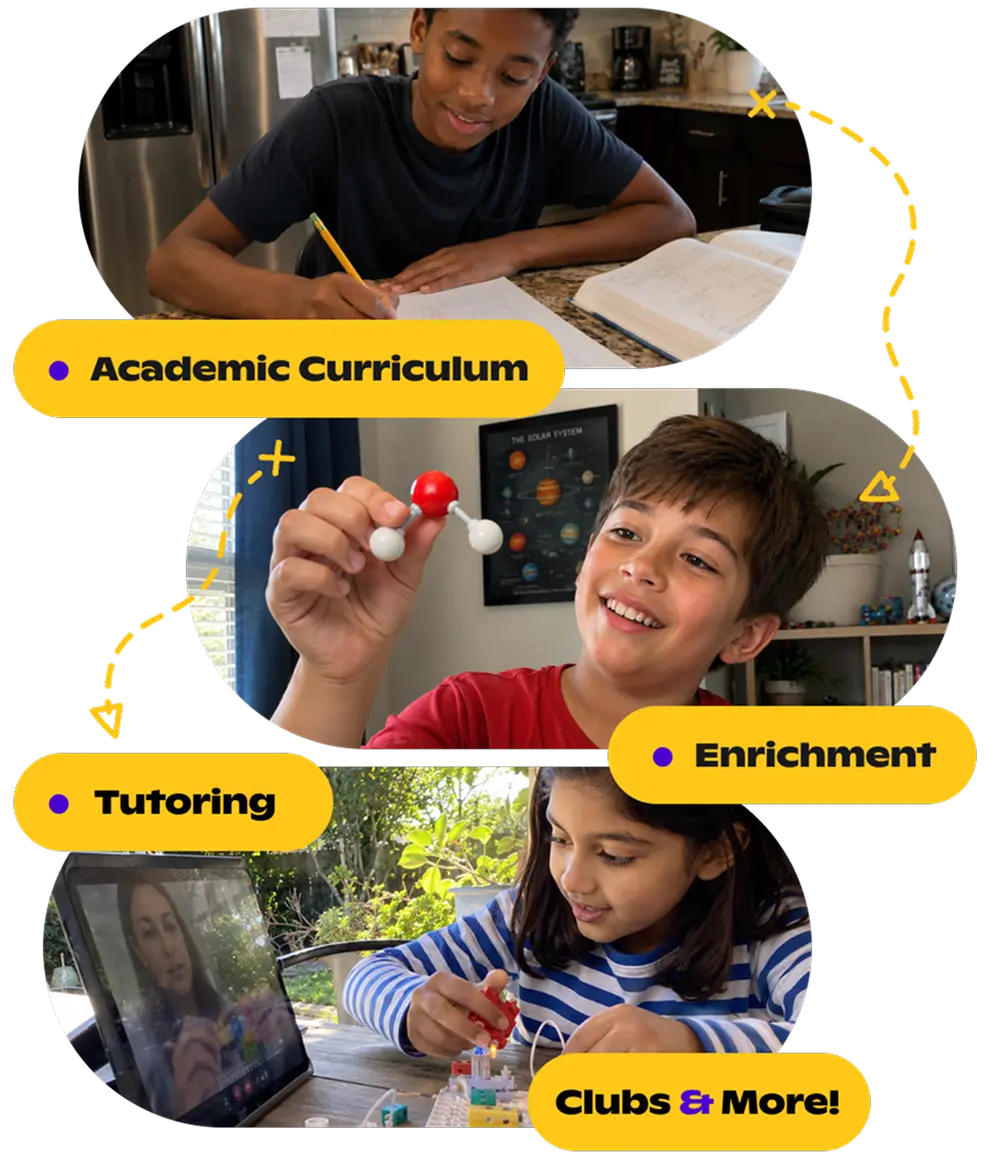
Live online classes, taught by real teachers in small groups, fill a specific gap in many homeschool curricula: subjects the parent isn't confident teaching, subjects the child needs taught by a different person, or enrichment topics that go well beyond what any single curriculum can cover.
$20 off your first class WITH promo code: blog
Build the Education your Kid Deserves
Discover thousands of live classes taught by expert teachers, across academics and enrichment.
Browse classesHow online classes fit into a homeschool curriculum
Online classes work best when they're added deliberately, not as a substitute for a full curriculum plan, but as specific pieces that complete it.
Common ways homeschooling families use live online classes:
- Outsourcing subjects outside the parent's expertise: High school chemistry, advanced algebra, a second foreign language, music theory.
- Adding accountability and structure: Some kids produce better work when there's a teacher expecting it on a specific day.
- Social enrichment: Classes give kids regular contact with other learners, which is particularly valuable for kids who thrive in a discussion format.
- Deep-diving into genuine interests: Robotics, forensic science, manga drawing, creative writing workshop, subjects a standard curriculum doesn't reach.
On Outschool, classes are offered in live small-group sessions with 2–12 kids, with teachers who set their own scheduling and pace. You pay per class or per semester with no subscription required. Browse by subject: math enrichment, reading and writing, and hundreds of elective options beyond core subjects.
What a homeschool curriculum plan looks like in practice
There's no single right format, but most families find it useful to build their plan around:
- A weekly rhythm, what happens each day, how long each subject block runs
- A subject-by-subject list of what curricula or resources you'll use for the year
- A loose scope and sequence, what topics you plan to cover in what order
- Built-in flexibility for the things you'll want to change (and you will want to change some things)
Most experienced homeschoolers recommend planning loosely for the first semester and more specifically for the second, once you know how your child actually responds to the materials you've chosen. Buying everything up front before you've tested any of it is one of the most common first-year mistakes.
If you're building your first curriculum plan, the guide to building a curriculum for neurodiverse students is worth reading even if your child doesn't have a formal diagnosis, it covers practical planning principles that apply to any learner.
Frequently asked questions
Can I make my own homeschool curriculum from scratch?
Yes, and many families do, especially those following an eclectic or interest-led approach. Building from scratch means sourcing materials subject by subject and planning your own scope and sequence. It takes more up-front planning but gives you complete flexibility. Most families find a middle ground: a spine curriculum for core subjects with supplemental materials layered in.
What subjects are legally required for homeschooling?
Requirements vary by state. Most states require instruction in English/language arts, math, science, and social studies at a minimum. Some require additional subjects like health, physical education, or fine arts. Check your state's specific homeschool laws before finalizing your subject list, the requirements are often simpler than they sound.
How much does a homeschool curriculum cost?
Annual costs vary widely, from under $200 using free and library resources to $2,000–$3,000 for complete packaged curricula. Most families using a subject-by-subject approach with online classes land somewhere between those extremes. ESA-funded families can use education savings account funds to cover many curriculum and class costs directly.
How do I know if my homeschool curriculum is working?
The clearest signals are engagement and retention: is your child interested in the material, and are they retaining what they've covered? If your child is consistently frustrated, bored, or avoiding a subject, the curriculum, not the child, is usually the issue.
How do I build a homeschool curriculum for a child with learning differences?
Start by understanding the specific learning profile, what's hard, what's easy, what supports help. Then build the curriculum to accommodate those needs from day one, rather than applying accommodations to a standard curriculum later. Our curriculum guide for neurodiverse students is a solid starting point.


.svg)
.svg)